

What Hormones Contribute to Your Masculine Features?
Many think testosterone is the only male hormone. Nothing could be further from the truth.
Our culture is obsessed with this one androgen hormone, yet it is part of a group of hormones that give men their male characteristics.
Do you want to gain performance, enduring strength, and a youthful appearance while maintaining a healthy heart and liver? Then, regardless of your age, you need to know how your testosterone (T) is working with other hormones.
Women Learn About Hormones Early—Why Not Men?
In many ways, women have it easier, but they are certainly coached earlier in life on what they might expect from the impact hormone fluctuations can have on their bodies. Every month, women are reminded of their hormones through physical and emotional symptoms in an outward presentation of menstruation.
Conversely, and let’s be honest, most men are not encouraged to seek a hormone education, let alone teenage boys. Or, if they are, it’s rare. And yet, their bodies go through equally impactful hormonal cycles, which, just as in women, drive not just their energy and cravings (physical or otherwise) but their decision-making and drive.
Men's health needs are vastly different from those of women. Is your nutrition focused on maintaining your sexual and prostate health? Are your hormones in proper balance? Not sure? Knowing your numbers is the easiest way to make sure your health is on the right path now and in the future—so you can take action if your testosterone levels are low, you’ve shown markers for disease, or your vitamins and minerals are outside of the normal range.
In many medical publications, the description of the decline of testosterone and other hormones looks like a slow journey stretching over many years—which would be true if we existed in a bucolic vacuum, but we don’t.
Hormone changes, subtle as they may be on their own course, are aggravated by the constant barrage of commonplace environmental toxic factors.
Males go through hormonal cycles, which, just as in women, drive not just their energy & cravings (physical or otherwise) but their decision-making and drive. And while they do have an outward presentation of these shifts, culturally we are not raised up in the awareness of these as being symptoms of hormone cycles. Add to that the prevalence here in the States of raising up boys to be “strong and self-sufficient” in order to truly become “men,” and we have generations of men struggling, suffering anxiety, absentmindedness, withering libido, and overall strength alone.
We’re here to say, “No longer.”
This may feel like uncharted territory, menfolk, and we want to reassure you that there are landmarks.
Androgens are a group of sex hormones. They help start puberty and play a role in reproductive health and body development.
All genders make androgens, but males make more of them. Testosterone is the most common androgen. The testicles in the male reproductive system and the ovaries in the female reproductive system make androgens. The adrenal glands that sit on top of each kidney also produce these hormones.
In all genders, androgens help with:
Bone density.
Muscle development.
Puberty.
Red blood cell production.
Sexual desire and function.
Testosterone is the predominant androgen in all genders.
Why check testosterone (T) hormone levels?
Testosterone is an important hormone. It can affect bone health, boost libido, grow muscle mass, stimulate red blood cell production, alter fat distribution, sharpen memory, enhance strength, and bump up energy.
There is a marked reduction in testosterone (T) production around ages 38–42 for most men. Medically referred to as andropause, our culture calls it a man's midlife crisis.
Many men find it difficult to acknowledge there may be a problem, refusing to even talk about the symptoms. Unlike menopause in women, andropause in men is rarely studied. There are about 100 published articles on menopausal women for every 1 article published on andropausal men. This makes it difficult for men to understand what's happening to them.
With the growing number of impulses to stay young, men going through andropause may begin to act out atypically. Classic signs of men going through a "mid-life crisis" are when they suddenly begin spending money on sports cars, going after younger women or men, wearing inappropriate youthful clothes, or exploring bisexuality—essentially any activity chasing his youth.
What Causes Low Testosterone (T) in Young Men?
Testosterone treatment decreases sperm production by decreasing levels of another hormone, follicle-stimulating hormone (FSH), which is important for stimulating sperm production. In most cases, infertility caused by testosterone treatment is reversible.
What are the symptoms of low testosterone (andropause)?
Behind every earnest ambition, desire, and motivation, there is a hormone driving it. Hormones signal the body to release the energy needed for the pursuit.
Many emotions are influenced when male hormones are out of balance. Common causes for hormone imbalance in men can even be the result of bad relationships or being sedentary for long periods.
Men can get temperamental quickly, lethargic to the point of sitting around the house for days, easily bloated with the smallest amount of food, sensitive to cold, lose the desire for intimacy as a result of low libido, or be challenged to put on lean muscle bulk and to keep it on.
Testosterone also helps regulate the breakdown of fat to provide your body with energy. So having a healthy testosterone balance helps your body burn the right amount of fat. Clearly, testosterone is indispensable to your health and metabolic performance.
One possible cause of unexplained anemia in older men is testosterone deficiency because serum testosterone levels decline as men age
How Aging and Toxicity Affect the Decline of Male Testosterone
Aging is not the only factor in declining hormones in men. Toxins affect hormone levels. Toxins are everywhere—in the home, at work, and in man-cave places like the basement or garage.
Household chemicals, skin care items, plastic containers, processed food, and medications disturb the balance.
Avoid masking the problems of aging or toxicity with pills, steroids, or aggressive supplement stacks. Instead, check your hormone levels first and then correct them from an informed position. To do that, you have to know your true hormone values and put a plan together that's based on the hormone test results you get.
Think of the young athlete managing his supplements & powders, eating his brown rice, steamed broccoli, and dry chicken breast, lifting HARD, and yet not making the anticipated gains. Or the sedentary white-collar worker in his late 30s or early 40s, in a bit of a rut at work, maybe making some less-than-optimal food choices, and now experiencing rapid-onset gut and man-boobs with an equally flagging libido. Hold UP!
Poor results are not just the food and the lack of working out, or, in the case of the athlete, the wrong supplement cocktail or a bad choice in a carb-heavy protein shake. These things may certainly contribute to their lackluster results, but it will be their hormone levels that are more likely at the root of their troubles.
There are a lot of hormones "under the hood" contributing to a man's overall appearance, attractiveness, motivation, and passion.
Here are a couple of common stories:
Working out hard? Watching your supplements and powders but not seeing the results you’ve mapped? Feeling drained instead of buoyed—not just post-workout, but hours after? Not recovering the way you once did? Or perhaps you know you should be?
Maybe feeling like your age doesn’t match your energy level? Watching your waistline grow and muscles flag, perhaps along with your libido? Not a big 'workout type of guy,’ but (mostly) getting your steps in and, yeah, mostly making decent food choices but questioning. No, you’re not 22 anymore, but still... Is it screen time? The desk job you worked so hard for? These damnable pants?
To the untrained or unformed eye, these outward symptoms may easily be misleading. With widely assumed cultural markers directing us, we may fall to working out harder & salads for lunch—still to no avail. Thus the cycle continues.
Men's Vitality Hormone Profile Suite
Maximize the benefits of your fitness and health regimen. Tracking your hormone levels prevents ineffective strategies, unnecessary supplements, and disappointing results.
We’ve formulated three CLIA-certified hormone test profiles designed to provide progressively deeper insights into male hormonal health:
- Men’s Vitality Core Profile: 8 tests, a foundational assessment of key hormones that regulate testosterone balance, metabolism, and recovery
- Men’s Vitality I Profile: 12 tests, builds on Vitality Core Profile by expanding insights into Thyroid Metabolism assessment
- Men’s Vitality II Profile: 13 tests, builds on Vitality Core Profile by assessing precursors, excitatory, and inhibitory hormones affecting the production and efficacy of testosterone. Optional Add-on: 4 tests for Thyroid Metabolism assessment
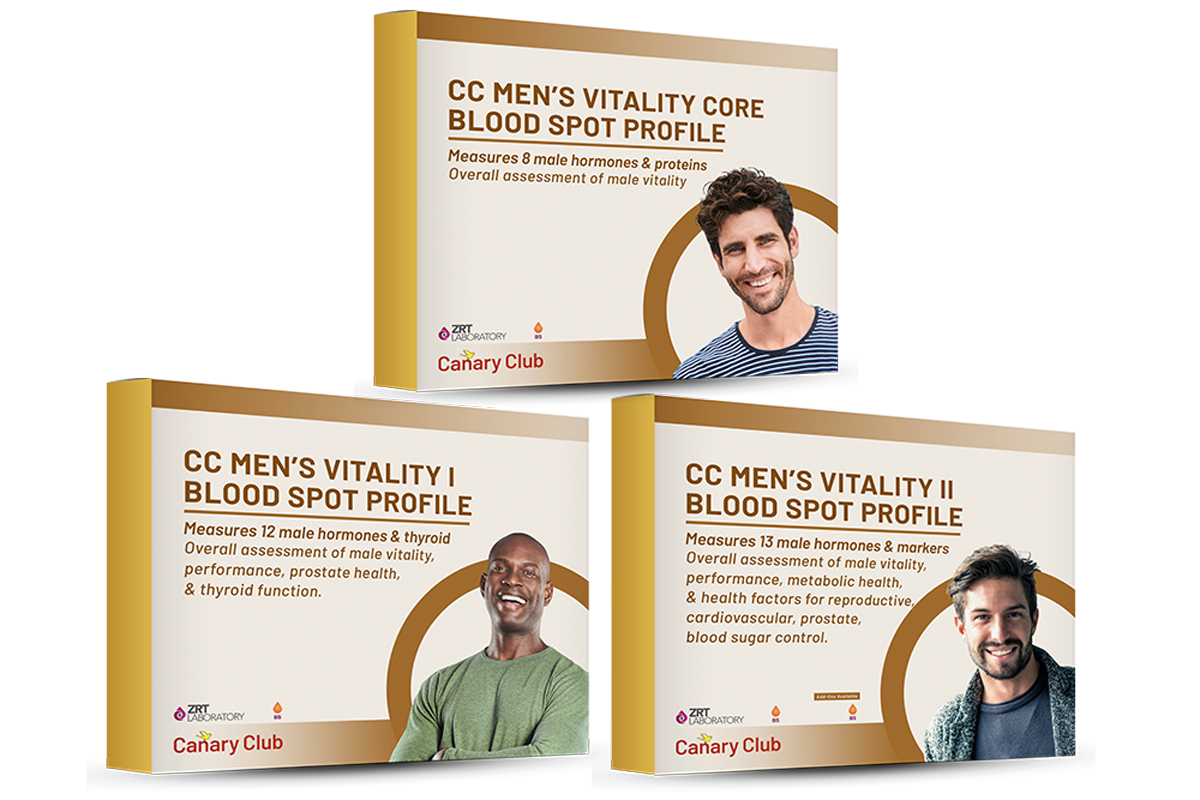
Profile Key Differences
| Hormone or Metabolite Tested | Vitality Core | Vitality I | Vitality II |
|---|---|---|---|
| E1, E2, Pg, T, DS, C (LCMS) | ✅ | ✅ | ✅ |
| SHBG, PSA (LIA) | ✅ | ✅ | ✅ |
| Thyroid (TSH, FT3, FT4, TPOab) (LIA-EIA) | ❌ | ✅ | ✅(add-on) |
| LH, FSH (LIA) | ❌ | ❌ | ✅ |
| A1c, Insulin (ITA, EIA) | ❌ | ❌ | ✅ |
| hsCRP (EIA) | ❌ | ❌ | ✅ |
Choosing the Right Test for You:
Selecting the right hormone panel depends on your health goals and concerns. Here’s a simple guide to help you decide:
-
Men’s Vitality Core Profile (Blood Spot)
- Best for foundational insights into male hormone balance and prostate health.
- Ideal if you want to monitor testosterone levels, estrogen balance, stress hormones (cortisol & DHEA-S), and prostate health (PSA).
-
Men’s Vitality I Profile (Blood Spot)
- Includes everything in the Core Profile plus a full thyroid metabolism assessment.
- Best if you're experiencing fatigue, weight gain, or slow metabolism and want to assess thyroid function (TSH, Free T3, Free T4, and TPO antibodies).
-
Men’s Vitality II Profile (Blood Spot)
- Most comprehensive—assessing not just testosterone and thyroid (add-on) but also fertility markers, inflammation, and blood sugar regulation.
- Best for those concerned with testosterone production signals (LH & FSH), metabolic health (A1c, insulin), and inflammation (hsCRP).
Additional Resources:
- Unleashing Your Power: The Impact of Male Hormones
- Why Hormones Matter for Men at Any Age
- How Men's Hormones Make for Mood Spikes
- Estrogen is Essential
- Testosterone Controversy: Can Supplements Make You Young Again?
- Men and Hormones : Male Menopause
- Growth Hormone and Resistance Training
- Andropause Subtle Yet True
- His Advanced Plus
There are no quick-fix solutions for men. Get the bigger picture by evaluating several hormones at once—to better plan the changes needed to enhance or maintain your male characteristics. There are healthier ways, after all, to look your best without having to be a slave at the gym every day.
--------------------------------------------------------------------------------------
"Knowing yourself is the beginning of all wisdom.”
Aristotle
Clichés are what they are because after hearing them so often, if we get numb to them, we forget that they’re TRUE. Aristotle was, and still is, right. Knowing ourselves is absolutely the first step on the road to expansion. That’s not to say it’s a one-and-done kind of deal—most certainly not!
Flip the switch. Look in the mirror, BOOM! I know myself and am suddenly a sage! Nope. And yet, accept the invitation, begin to look deeper, and layer by layer understanding dawns, and with it, wisdom makes herself known. And that, friends, is a reason to celebrate. 🎉💃🏽
We are here to celebrate with you. Let us know what is working for you and where you could use more support. We are honored to be on this road together.
From all of us at the Canary Club,
Here’s to knowing ourselves and taking positive action!