

Reduced hormone levels due to natural aging can affect men, too!

Sometimes referred to as "male menopause," andropause is the age-related decline in a man's testosterone levels.
These declines can cause some unwelcome changes, just as menopause can. In a recent article, Candace Burch, M.A., hormone educator, said:
"And there is little doubt that when muscles morph into body fat and sexual fizz fizzles out, men may worry that they are becoming less than human. But the red convertible, younger gal pal, and Viagra won’t bring back the man they were if an unhealthy lifestyle and hidden hormone imbalance go unaddressed. The fact is, low testosterone or any measurable deficiency of testosterone generally goes along with deficient DHEA and undetected imbalances of related hormones."
Compared to menopause, there’s no question that testosterone is the hormone that puts the macho in males: that virility, hairiness, heavier bone and muscle mass, deeper voice, and aggressive competitive drive we associate with the male of the species. Andropause is a much more gradual process, with men having declines in testosterone of about 1 percent a year after age 30, which can sometimes reach half of the normal levels by age 70. By age 45-50, though, testosterone can already be at deficiency levels, which are regarded as levels below 350 nanograms per deciliter (450-900 ng/dl are optimal).
Northwestern Memorial Hospital states that their experts currently estimate over five million American men are negatively affected by andropause and what is medically known as male hypogonadism, when the testicles do not produce sufficient testosterone. Yet, many of these American experts also worry that many more men may be affected because men frequently ignore their symptoms without reporting them to their doctors. “This is a highly prevalent disorder,” said Robert Brannigan, MD, a urologist at Northwestern Memorial Hospital, in the same August 2010 press release. “Unfortunately, we estimate that 95 percent of cases are undiagnosed and therefore untreated. When ignored, symptoms can seriously disrupt one’s quality of life."
Symptoms of men having insufficient levels of testosterone are believed to include these, as described by the Mayo Clinic:
- Physical Changes: increased fat, reduced muscle, decreased bone density, and energy loss.
- Less common symptoms can also include smaller testes, swollen or tender breasts, loss of body hair, and even hot flashes.
- Sleep Changes: Insomnia or increased sleepiness.
- Sexual Changes: Reduced sexual desire, erectile dysfunction, fewer spontaneous erections (such as during sleep), and infertility.
- Emotional Changes: Poor concentration or memory, decreased motivation or self-confidence, sadness, and depression.
Do keep in mind that testosterone and low T are not just a guy thing; women, too, need adequate T to maintain sexual function, strengthen bones and muscles, and boost mental clarity and libido, though women’s bodies make a lot less...
Another study, however, published in June 2010 in the New England Journal of Medicine and conducted by a team of researchers from English and European universities, concluded that having the three sexual symptoms of "decreased frequency of morning erection, erectile dysfunction, and decreased frequency of sexual thoughts (sex drive)" were the only symptoms that actually turned out to be correlated with low testosterone levels.
The European Union-funded European Male Ageing Study randomly sampled 3,369 men ages 40 to 79 at eight European centers. The lead author of the study, Dr. Fred Wu, a professor at the University of Manchester's School of Biomedicine, and his colleagues suggest that "unlike female menopause, which generally affects all women, the male menopause only affects about 2 percent of elderly men and is often associated with obesity and poor general health."
Fortunately, Canary Club offers convenient, easy-to-use home hormone tests, so don't wait if you suspect that you might be suffering from insufficient testosterone. Put your mind to rest with our quick and simple test!
In addition, if it turns out you or a loved one does have low testosterone levels, be aware that the latest study refutes the claim that testosterone replacement therapy (TRT) can increase or cause prostate cancer. This now-defunct idea came out of studies in the '40s and the '80s. Instead, Harvard Professor Dr. Abraham Morgentaler showed in 2011 that testosterone levels above 120 ng/dl actually suppressed prostate cancer growth and that any appearance of growth in the original studies would only seem to be seen until sufficient saturation of testosterone occurred.
In summary, the jury is still out on the effect of andropause in men. Many of the suspected symptoms associated with andropause may be a natural part of aging or related to other causes and illnesses. Therefore, a testosterone test may be the best and only way to determine if a deficiency exists.
Men's Vitality Hormone Profile Suite
Maximize the benefits of your fitness and health regimen. Tracking your hormone levels prevents ineffective strategies, unnecessary supplements, and disappointing results.
We’ve formulated three CLIA-certified hormone test profiles designed to provide progressively deeper insights into male hormonal health:
- Men’s Vitality Core Profile: 8 tests, a foundational assessment of key hormones that regulate testosterone balance, metabolism, and recovery
- Men’s Vitality I Profile: 12 tests, builds on Vitality Core Profile by expanding insights into Thyroid Metabolism assessment
- Men’s Vitality II Profile: 13 tests, builds on Vitality Core Profile by assessing precursors, excitatory, and inhibitory hormones affecting the production and efficacy of testosterone. Optional Add-on: 4 tests for Thyroid Metabolism assessment
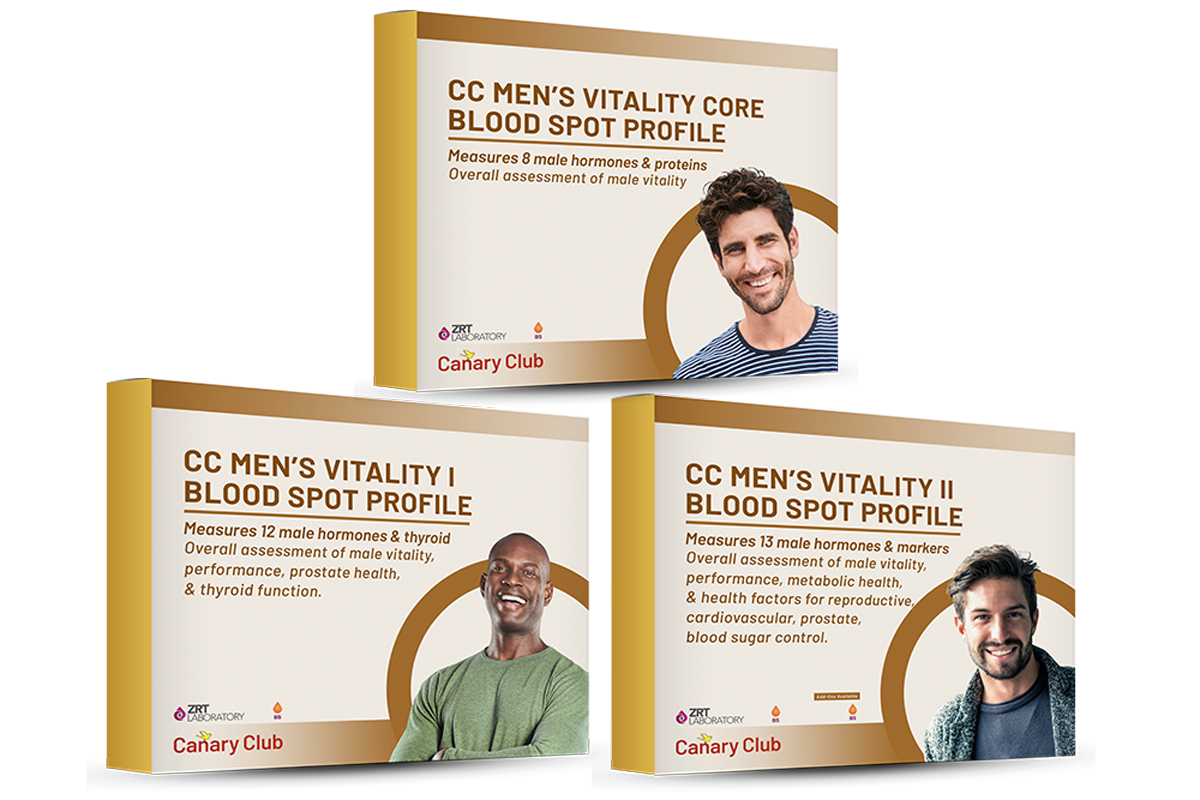
Profile Key Differences
| Hormone or Metabolite Tested | Vitality Core | Vitality I | Vitality II |
|---|---|---|---|
| E1, E2, Pg, T, DS, C (LCMS) | ✅ | ✅ | ✅ |
| SHBG, PSA (LIA) | ✅ | ✅ | ✅ |
| Thyroid (TSH, FT3, FT4, TPOab) (LIA-EIA) | ❌ | ✅ | ✅(add-on) |
| LH, FSH (LIA) | ❌ | ❌ | ✅ |
| A1c, Insulin (ITA, EIA) | ❌ | ❌ | ✅ |
| hsCRP (EIA) | ❌ | ❌ | ✅ |
Choosing the Right Test for You:
Selecting the right hormone panel depends on your health goals and concerns. Here’s a simple guide to help you decide:
-
Men’s Vitality Core Profile (Blood Spot)
- Best for foundational insights into male hormone balance and prostate health.
- Ideal if you want to monitor testosterone levels, estrogen balance, stress hormones (cortisol & DHEA-S), and prostate health (PSA).
-
Men’s Vitality I Profile (Blood Spot)
- Includes everything in the Core Profile plus a full thyroid metabolism assessment.
- Best if you're experiencing fatigue, weight gain, or slow metabolism and want to assess thyroid function (TSH, Free T3, Free T4, and TPO antibodies).
-
Men’s Vitality II Profile (Blood Spot)
- Most comprehensive—assessing not just testosterone and thyroid (add-on) but also fertility markers, inflammation, and blood sugar regulation.
- Best for those concerned with testosterone production signals (LH & FSH), metabolic health (A1c, insulin), and inflammation (hsCRP).
Additional Resources:
- Unleashing Your Power: The Impact of Male Hormones
- Why Hormones Matter for Men at Any Age
- How Men's Hormones Make for Mood Spikes
- Estrogen is Essential
- Testosterone Controversy: Can Supplements Make You Young Again?
- Men and Hormones : Male Menopause
- Growth Hormone and Resistance Training
- Andropause Subtle Yet True
- His Advanced Plus
Your Hormone Management Testing Plan
- Step 1: Start by selecting and ordering your desired test(s). You will receive an at-home testing kit that fits your unique concerns and needs. No prescription or visit to the doctor’s office is required. Your test kit is delivered directly to your front door.
- Step 2: Take the test to establish the starting hormone baseline at the beginning of your plan. Consider developing your plan alongside:
- a licensed health care provider for medical conditions, especially for severe "out of normal range" results
- or a Health Care Coach for nutrition and supplements that will support your desired results
- Step 3: Develop a plan based on your hormone test results, establishing a one-year or more outlook.
- Keep logs of your intakes, and daily routines related to your hormone test results.
- Keep logs of your intakes, and daily routines related to your hormone test results.
- Step 4: After 6-12 months of actively working on your plan, take the same test again to determine your progress.
References:
Hoyt, Steve. (2012, November 16). Andropause: A Diagnosis Whose Time Has Come. Santa Barbara Independent. Retrieved from http://www.independent.com/news/2012/nov/16/andropause-time-has-come/
Mayo Clinic Staff. (2011, July 23). Male menopause: Myth or reality? Mayo Foundation for Medical Education and Research. Retrieved from http://www.mayoclinic.com/health/male-menopause/MC00058
Medical News Today. (2010, June 17). Researchers Identify Symptoms of Male Menopause. MediLexicon International Ltd. Retrieved from http://www.medicalnewstoday.com/articles/192043.php
Northwestern Memorial Hospital. (2010, August 20). Male Menopause Affects More Than Five Million Men. NMH.org. Retrieved from http://www.nmh.org/nm/Male-menopause